
YES, this is a ‘BLURB’!
A satirical term that became an industry standard

Our podcast is available for free, but producing the show costs money. If you enjoy listening and can afford to, please consider becoming a paid subscriber.
It’s always a good time when Andrea Nguyen, Kate Leahy, Kristin Donnelly, and I get together to record an episode of the show. It is, after all, how the podcast started: four experienced cookbook-authors-turned-friends sharing ideas, opinions, advice, and encouragement. These chats remind us of the importance of finding community in our work and give us a chance to dig into singular topics, both small and large. No matter the subject, I’m always happily surprised by how much there is to talk about—and how much I learn talking with my co-hosts.
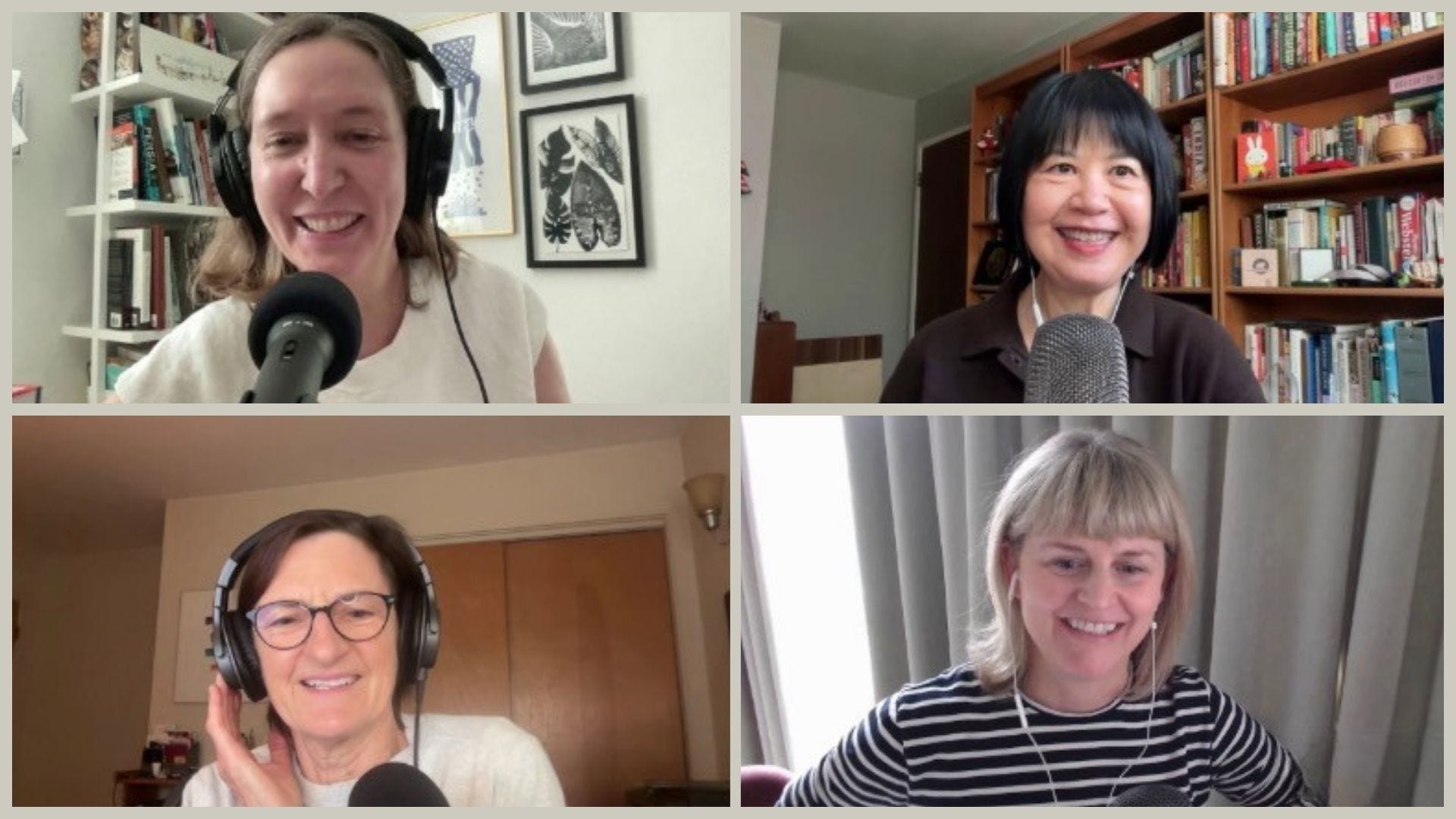
At the top of our conversation about Blurbs: Do They Actually Matter?, Andrea addresses the elephant in the room: the word itself. “Can we first talk about the word?” she asks. This got me wondering about the word’s origin and how it became an industry standard across genres.
Merriam-Webster cites1 a 1907 annual dinner of the American Booksellers' Association as the first known usage of the term by Frank Gelett Burgess2, author, poet, and humorist. At these dinners, attendees would receive promotional copies of books written by guest authors. Burgess took the opportunity to mock the industry’s tendency toward exaggerated praise by distributing a spoof book jacket featuring an image of a woman shouting to the rooftops, captioned "Miss Belinda Blurb in the act of blurbing." The headline reads: “YES, this is a ‘BLURB’! All the Other Publishers commit them. Why shouldn’t we? “ The paragraph that follows is a flood of empty, over-the-top praise for the ersatz book, with lines like:
“When you've READ this masterpiece, you'll know what a BOOK is.”
Seven years later, Burgess takes things further by including the term, blurb (as both a noun and a verb) in his humorous and inventive dictionary, Burgess Unabridged: A New Dictionary of Words You Have Always Needed.
Blurb, n. 1. A flamboyant advertisement; an inspired testimonial. 2. Fulsome praise; a sound like a publisher.
Blurb, v. To flatter from interested motives; to compliment oneself.
On the ‘jacket’ of the ‘latest’ fiction, we find the blurb; abounding in agile adjectives and adverbs, attesting that this book is the ‘sensation of the year.’
Learning this history helps to understand why the word itself sounds so funny. It was meant to be! It’s also a good reminder that the public has long been suspicious of overselling and overzealous promotion. Even so, the term endured, and while it remains a silly-sounding word, it can be serious business for publishers, book sellers, and authors.
There’s a lot of discussion lately about whether or not blurbs help sell books. Some writers and industry critics see them as a sign of all that is wrong with publishing3. Others assert, much like Burgess over a century ago, that blurbs are too often meaningless and overplayed. But I think novelist Emily Temple sums things up neatly by describing the term as “a little ugly, a little like a puddle, but juicy, taking up space, defiant and happy to be here.”4
Whatever your stance, blurbs remain a part of the cookbook world and something authors must contend with. The episode is packed with information and thoughts on how to go about getting blurbs for your cookbook and what to do if you’re ever asked to blurb someone else’s work. There’s plenty of good, juicy reading in the links below, too. As always, we’d love to hear your thoughts on the topic - or the word itself!
Links from the episode:
“On the Origin of the Word ‘Blurb’” by Emily Temple
“Blurb Your Enthusiasm” by Sally Ekus
“We Need to Talk About Blurbs” by Kathleen Schmidt
“Are Publishers Dropping Blurbs?” by Lisa Tener
“Here’s How Social Media Is Changing Book Blurbs” (NPR, May 2025)
“Author Blurbs: Do They Matter?” by Alessandra Torre Ink
The Literary Favor Economy: In Praise of the Oft-Maligned Book Blurb by Ada Calhoun
‘A Plague on the Industry’: Book Publishing’s Broken Blurb System by Sophie Vershbow
A Bird in the Hand by Diana Henry
Visit the Everything Cookbooks Bookshop to find books mentioned in the show. (Buying books here supports the show, independent bookstores, and authors. A win-win-win! 🏆)
Next up on EVCB:
Tanya Bush joins us to discuss her cookbook/memoir, Will This Make You Happy. We get into her thoughts on why she chose to write this particular blend of genres and her hopes for the book. Until then, keep on writing, reading, and cooking. ✍️📚🍳
Molly and the EVCB crew
Lots of ways to support Everything Cookbooks
We appreciate your ❤️s, comments, and restacks, too. We cherish paid subscriptions, as well. There’s even a special category for superheroes for our super fans.
Shop for EVCB merch on our website. Any book mentioned on the show can be found at our affiliate shop on Bookshop.org. Every bit of support helps!
Frank Gelett Burgess, born on January 30, 1866, in Boston, was an American artist, author, and humorist. Perhaps best known for his 1985 poem, The Purple Cow.
awesome!!!
The smashing history of “blurb” made me crack up!!!!